
 By Admin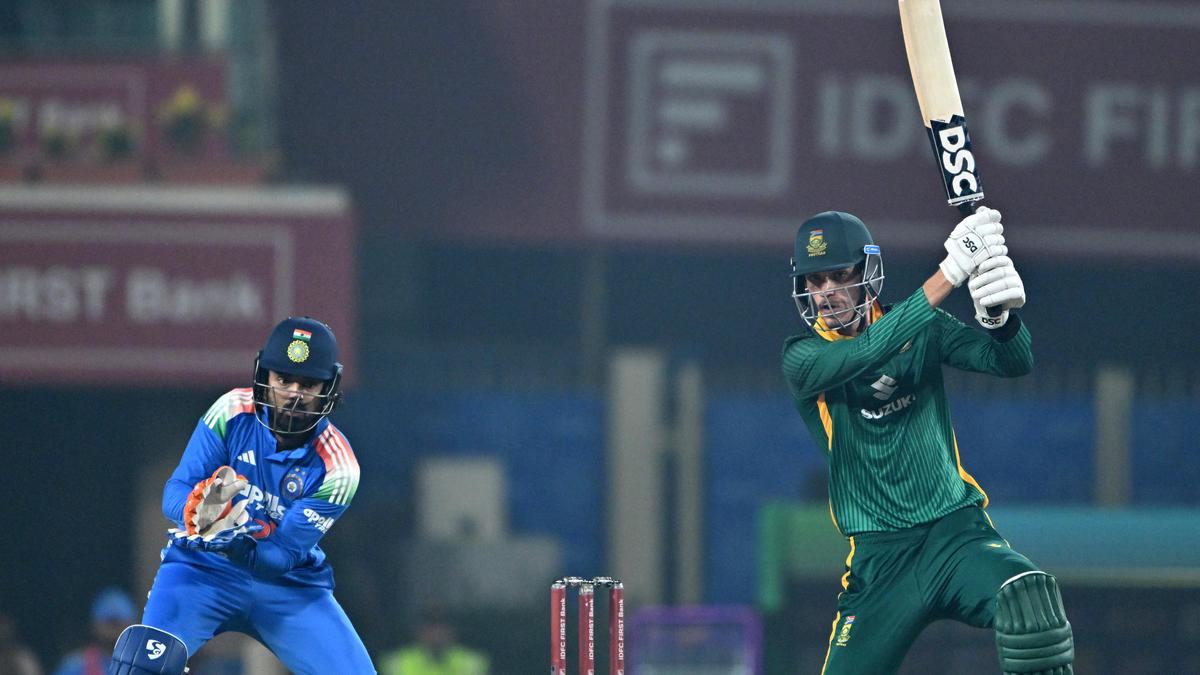

Marco Jansen’s rapid evolution as a genuine fast-bowling all-rounder has given South Africa a rare two-in-one asset at a time when world cricket is short on pacers who can influence matches with both bat and ball.
The 25-year-old left-armer, once viewed primarily as a new-ball prospect, has grown into a player capable of shaping sessions with the ball and altering momentum with his batting, making him central to South Africa’s long-term plans across formats.
Jansen’s bowling remains his biggest currency — steep bounce, natural angle across right-handers and the ability to extract movement even on slowing surfaces have already earned him several match-shaping spells.
His fuller length and improved control have added layers to his threat, pushing him into the leadership bracket of South Africa’s attack. Yet it is his batting progress that has elevated his overall value and offered balance the side has long missed.
No longer a hit-or-miss tailender, Jansen now walks in with a clearer method, often rescuing South Africa from difficult positions or extending competitive totals into winning ones.
“It’s always nice to walk in when the top five are on a roll. I’m just watching the ball and playing it as it comes. At the moment it’s working for me,” Jansen said.
His most compelling statement with the bat came in the recent Guwahati Test against India in November 2025, when he smashed a 91-ball 93 at No. 9 to pull South Africa out of trouble.
Walking in at 334 for seven, he counter-attacked a tiring Indian attack with six fours and seven sixes, nearly becoming the first visiting No. 9 to score a Test hundred in India in more than six decades.
His assault lifted South Africa to a formidable 489 — a total that shifted the course of the match and allowed their bowlers to control proceedings. The significance of the knock was amplified by the match situation and the fluency with which he scored on a slowing surface.
This was not an isolated burst. Jansen had earlier produced a gritty 59 at Wellington to lift South Africa from a precarious position and steer them to a competitive first-innings total.
In limited-overs cricket, his cameos have carried increasing weight: a brisk 35-ball 42 against India in Gqeberha in a rain-revised ODI kept South Africa ahead of the DLS target, while his late hitting in the Kimberley ODI — where he scored 38 off 26 — pushed the team to a defendable score in a match they went on to win.
These contributions, though lower down the order, have regularly arrived at pressure moments, and underline why South Africa now view him as a genuine lower-order asset rather than a bowler who can bat.
Stacked against the game’s other contemporary fast-bowling all-rounders, Jansen’s trajectory stands out. While someone like Cameron Green offers stronger batting numbers, he doesn’t match Jansen’s hostility with the ball.
India’s Hardik Pandya’s impact is limited by workload restrictions, and England great Ben Stokes — incomparable for influence — no longer bowls consistently.
Among specialists who can deliver with both speed and bounce, few possess the ceiling that Jansen currently projects.
What keeps him firmly in the conversation for the best emerging all-rounder is his adaptability.
In Tests, he offers breakthroughs with both new and old ball while adding crucial runs.
In ODIs and T20Is, his ability to hit the deck and swing late, combined with clean hitting at No. 7 or 8, provides South Africa with balance and flexibility.
His challenge now will be to stitch together seasons of consistent returns with both bat and ball. If that happens, South Africa may well have in Jansen their most influential seam-bowling all-rounder since Jacques Kallis, albeit of a very different mould.